Sima
two-act opera by Leonard Lehrman,
after "The Krasovitsky Couple"
by David Iakovlevich Aizman (1869-1922),
story translated from the Russian
by Edgar H. Lehrman (1926-1986)
dedicated "to Nadia Boulanger, who taught me fugue,
my Grandma Sima Glukhovskaya Rosenstein Peterson Yaffe
my cousin, Lyuba Borisovna Glukhovskaya (later Sechar)
and Carol Skinner"
presented in concert Aug. 6, 1976, then staged
by Ithaca Opera Assn, Oct. 22 & 23, 1976
at Barnes Hall, Cornell University;
broadcast on WCIC Cable TV May, 1977;
shown at festivals in Davos, Switzerland 1981
and Moscow, 1985
German premiere, in German, May 28, 1984
by Juedischer Musiktheaterverein Berlin
at Juedisches Gemeindehaus, Berlin
Excerpts performed in English, French, German, and
Russian in Switzerland, Germany, Israel, Australia,
Belarus, Russia, and the U.S.
Subtitled version of video posted in July 2021, here:
https://tinyurl.com/SIMAsubtitled.
The NY City orchestral premiere took place January 8, 2026 at Theater for the New City in Manhattan,
starring Christine Browning, Bennett Pologe, Perri Sussman, Samantha Long
and Hannah Grace Hollingworth as Sima, conducted by the composer.
Subsequent performances took place January 11, 16, 17, and 22. January 25 was snowed out.
Videos of Manya's Mad Scene and the final scene and Lullaby are posted here:
Act I Scene 4
Act II Scene 5
Links to private composite videos of the complete opera, subtitled, are available on request.
Videos of rehearsals, posted without authorization on Facebook, have been taken down.
An album of photos taken by Jonathan Slaff at the NYC premiere is posted here.
An additional album of photos he took of the children's chorus, here.
Press:
Podcast discussion with Andrew Cortes, "Whisper in the Wings," Jan. 4, 2026
"Leonard Lehrman's Sima and E.G.: A Musical Portrait of Emma Goldman:
Two Operas, One Warning: History's Unfinished Fight for Dignity, Justice, and Humanity"
review by Chris Ruel, 3 February 2026, OperaWire:
The ambiguous ending, which refuses to tie everything up neatly, was, in this reviewer's opinion, an excellent conclusion to the compact opera. While undoubtedly challenging for some (as evidenced by overheard comments), I enjoy untidy endings and the questions they provoke after the show. Open-endedness adds a layer of realism that is often missing from canonical works. Anti-catharsis is always a risk, but art without risk, where everything is explained, can be less intellectually engaging and more satisfying to the soul. This isn't a value judgment, as there's a place for both.
Individual Performances
The January 22 production featured Claire Iverson as Regina, while two earlier shows in the run starred Christine Browning. Both Iverson and Browning were hired at the last minute because the original vocalist dropped out of the production in December. This left the singers with little time to prepare and learn the music. Since I did not see Browning in the role, I cannot comment on her ability to step in, but Iverson's performance was excellent given the circumstances. Although she had to use an iPad with the score, she was very convincing as the vapid socialite. As a result, she performed the staged production in a quasi-concert style. It was an interesting combination that worked, demonstrating Iverson's talent, professionalism, and commitment.
Bennett Pologe (Yakov) was well cast as the brow-beaten husband trying to balance his wife's whims with the seriousness of dealing with striking workers and revolutionaries. He was sometimes comedic, but mostly he played a man exhausted by the times and his home life.
In the role of Manya, Perri Sussman delivered a compelling, non-cliche portrayal of a domestic on the brink of sanity. She was perhaps the most interesting character because she was given a backstory, and her break from reality was earned, not added just to create a mad scene or as a nod to Tatyana's letter-writing in Eugene Onegin.
Young Hannah Grace Hollingsworth portrayed the rambunctious and headstrong Sima. While earning sympathy from the audience for her character, she also showed the child's efforts to escape Regina's household by becoming a thorn in everyone's side. Her actions suggested a desire to return to the orphanage, but with Manya's sudden affection before the curtain fell, one was left to wonder whether Sima might face a better life with the Ukrainian as her adoptive mother than return to the orphanage.
Samantha Long as Lyuba, the orphanage supervisor, and Adele Grant as Zhena, Lyuba's assistant, both had successful outings.
The parallels between the United States today and an authoritarian regime's intent on terrorizing immigrants and citizens alike with deportation, imprisonment, and even death, naturally came to mind first.
Beyond the pogroms of the Russian Revolution, the exploitation of workers by industry remains just as true today as it was then. Big business cares little for labor; their only motivator is greed, humanity be damned.
Lehrman's score was chromatic but retained lyrical qualities. The composer included several Russian folk melodies, which helped connect the music more distinctly to the setting.
A common saying is that history doesn't repeat exactly, but it rhymes, and Sima is a great example of that.
"Bringing Her Home
Composer Leonard Lehrman on the Decades-Long Journey
to Get 'Sima' its NYC Premiere"
interview by David Salazar, 22 January 2026, OperaWire:
"It was a long road to get here," Lehrman told OperaWire during a rehearsal ahead of the Jan. 8 premiere.
Four Companies
"Sima" had previous performances in Ithaca, NY in 1976 and in West Berlin in 1984, respectively, but had yet to grace a stage in the Big Apple. It wasn't for a lack of trying though. Lehrman noted that four different companies had given the opera a look, but in the end couldn't find a way.
First up was Lehrman spoke to director Joseph Bascetta who moved fast.
"We actually cast it," Lehrman narrated. "I was working at the Metropolitan Opera at the time, and I got space at the Met to rehearse with the people that we had cast. We were offered the Beacon Theater on Broadway."
But then, Bascetta took one look at the theater and thought it was an impossible venue for the opera. The project was put back on ice.
Then came the New York Lyric Opera, "which was very interested in doing it."
"The director sat through and read that, listened to the whole video and was thinking of doing it," Lehrman explained. "And then he decided to do the magnum opus of my teacher, Elie Siegmeister, 'The Plough and the Stars,' based on Sean O' Casey's play. He did it at Symphony Space."
And that was it. The company folded soon thereafter and "Sima" never got a chance.
The final straw was After Dinner Opera Company, in tandem with Long Island Committee on Soviet Jewry. After Dinner Opera Company was founded in 1949 by Richard Flusser and the organization had done Lehrman's "New World: an opera about what Columbus did to the 'Indians,'" in 1991 and also co-sponsored the production of "Sacco and Vanzetti," in 2001 and then at Lehman College, directed by Ben Spierman, in 2022. The opera was started by Marc Blitzstein and Lehrman completed. The work was ultimately nominated for a Pulitzer.
In the 1990s, Flusser had considered "Sima" and he referred Lehrman to then-music director Conrad Strasser. Strasser played through the opera and as he did, Lehrman "already had people in mind to cast it." And while Strasser thought it was a "beautiful opera" he also felt it was "too much work."
As for the Long Island Committee on Soviet Jewry's involvement, the organization was very interested "until reality set in."
"They slowly realized that you don't raise money with an opera, you raise money for an opera. And opera doesn't make money, it costs money. And so they slowly distanced themselves from it," Lehrman explained.
A New Opportunity
But then in March 2024, Lehrman got a call that changed everything. A director at Theater for the New City was interested in working with the composer and the rest is history.
But the challenges didn't end there.
Rehearsals got underway and as the opening night approached, the lead soprano dropped out.
"It's been a crisis, but we were, you know, dealing with it as best we can," Lehrman said, noting that the company was able to bring on Christine Browning and Claire Iverson to do the role of Regina Krasovitzky, the lead in "Sima."
The Theater for the New City offered Lehrman 12 performances over three weekends, but there was no way he could pull off so many of just "Sima." So the decision was made to do six and use the remaining six shows for another of Lehrman's works: "E.G.: : A Musical Portrait of Emma Goldman." "The success of E.G. has been phenomenal," Lehrman concluded about the ongoing productions noting that regarding "Sima," "each performance has been better than the previous one."
"Life on the Outskirts of Society"
review by Beate Hein Bennet, New York Theatre Wire, 18 January 2026:
There were some very good performances: Young Hannah Grace Hollingsworth played the title character Sima with an assured grace and considerable emotional range. Perri Sussman sang and played Manya, the badgered Ukrainian maid to Regina, with a great range of expressivity and vocal strength. In a touching final aria, Manya is the one who accepts and shelters a frightened lost Sima. Samantha Long as Lyuba Borisovna, the supervisor of the orphanage, affects a strong emotional performance in guiding the children. The choristers, performed by children of various ages, worked hard at being individuals while at the same time portraying their common fate with hope in their eyes and irrepressible life energy. Bennett Pologe as the factory owner Yakov Krasovitsky, who is pre-occupied with his workers' discontent and pre-revolutionary activities, presents a malleable husband to a domineering wife but he holds his own in a vocally complicated musical duo. Lytza Colon designed the sets, Marsh Shugart designed the lighting. Period costumes are by Billy Little.
Critique by Joel [& Ellen] Mandelbaum, 19 January 2026:
We both enjoyed our night at the opera thoroughly.
Manya's aria, as sung by Perri Sussman, was the highlight of the evening
and some highlight it was! Were I a scout from the Met I would offer her
a contract on the spot and ask my committee on repertory to look into your
other 11 operas to see whether any of them maintains that level of engagement throughout.
Meanwhile, if there were a musical way to guide Manya's and Sima's emotions
from their mutual hostility to that lovely embrace at the end,
such music could serve the greater needs of our world for conflict resolution.
I realize that you are in distinguished company in focusing all your
compositional energies on magnifying our response to the injustices and greed in the world,
but it seems to me that your choice of ending in Sima,
where the two women find common cause and love in the situation
offers a composer his greatest (and most worthwhile) challenge,
to compose a kind of symbolic blueprint for
getting from here (hostility) to there (love) that can provide
an unconscious working model for situations both private and (ultra)-public.
Critique by Karen Ruoff Kramer, 31 January 2026:
I was extremely impressed with Sima, both as a composition,
at once high modern in its sophistication and nuance,
yet also accessible and deeply engaging; and as a production,
with strong performances of both singers and instrumental ensemble.
I was especially impressed with the performance of [the Regina]
who had boldly taken on a challenging star role with very little prep time;
the audience knew that she had jumped in very late
and and was not in the least disturbed that she used a tablet.
It did not detract; she consumed it deftly, it felt like a natural component of evening.
I was in fact deeply impressed with the way she finessed her interaction with it,
maintaining an a deep connection with the audience
through her voice, eye contact and body language.
It was an organic aid that made the production possible at all, not a Fremdkoerper.
I taught theater for 40 years at Stanford-in-Berlin, going to a production
of top Berlin theaters and operas with my seminars every week,
since 1000 performances in all. I am not a novice in this scene, and I am not easily impressed.
I have seen outstanding performances, and weak ones.
The Sima production is among the strongest and most striking I have seen in recent years.
It is a formidable piece of music, art, and delivered with mastery.
Of course I do understand if [the Regina], in her star role,
may have felt constrained by the tablet, I might have myself;
but I assure her that the audience, and certainly this audience member,
did not share that impression nor sense it for a moment.
She was sovereign and fully in her role; one that required expressing
conflicting impulses and emotions within the same torn psyche.
I admired both the confidence with which she embraced this opportunity
despite the problem of prep time, and with the way she so expertly performed the role.
Publisher: Carl Fischer
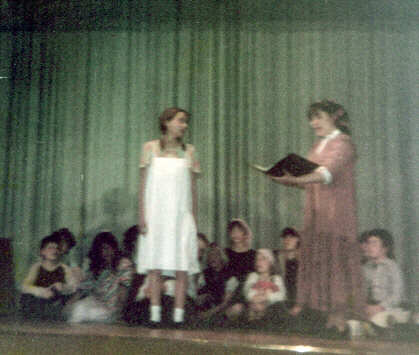
Photos at right by N.S. Lehrman from 1976 performances--
dir.: Glen Becker, cond.: Leonard Lehrman.
Watch the complete video of the 1976 production here,
or scene by scene:
Overture (& Opening Credits)
Act I Scene 1 The Streetcar
Act I Scene 2 Part 1 Arriving at the Orphanage
Act I Scene 2 Part 2 Ensemble
Act I Scene 2 Part 3 Departing the Orphanage
Act I Scene 3 The Carriage
Act I Scene 4 Manya's Letter Aria Mad Scene
Act I Scene 5 Coming Home
Entr'acte
Act II Scenes 1 & 2 Telephoning, Bathing
Act II Scene 3 Retiring
Act II Scene 4 Resolution
Act II Scene 5 Nightmares (Finale - & Closing Credits)
Audio excerpt posted online:
Lyuba's Aria, sung by Elizabeth Parcells,
Augsburg, Germany 7/21/80
Follow the text here.
Parcells also sang the role in the work's
European premiere, in Berlin, in May 1984.
A photograph of her in performance
with Christine Preussler in the title
role appears on Elizabeth's website.
Other excerpts posted on YouTube:
Lyuba's Aria introduced by the composer,
sung by Allison Mills 7/28/12
sung by Hannah Spierman 12/2/12;
Regina's "Mea Culpa" Aria sung by Kira Neary,
recorded at Court Street Music, Dec. 10, 2025.
Twelve days after making this lovely recording (in 5 takes) with the composer at the piano,
Ms. Neary announced that she was leaving the production, having rehearsed the role for weeks,
in order to take a better-paying job in Florida. Efforts to buy out her contract were in vain.
Time constraints compelled the production to replace her only
with singers who performed the role of Regina on-book,
one of whom requested removal of her name from all subsequent credits.
Manya's Lullaby sung by Helene Williams
7/28/12, 11/15/12, 12/01/14, 6/21/15
and in Russian translation
by Emily Lehrman & Dina Jitomirskaia
5/30/16, 6/11/16 in Minsk and 6/16/17 in Vitebsk;
by Galit Dadoun 3/30/14 and 11/09/14
and by Ute Gabriel, in German, 4/30/84.
Also by Perri Sussman, in English, 1/12/25.

Orphaned by a 1905 pogrom in the Ukraine,
the child Sima (Julie Gibbons)

mistakenly thinks she sees her mother in
Regina Krasovitskaya (Carol Skinner), a bored Jewish
housewife visiting the orphanage with her husband,
the factory-owner Yakov Isaevich Krasovitsky
(Paul Gibbons).

The couple decide to adopt the girl, despite the
misgivings of the orphanage supervisor, Lyuba Borisovna (Yvonne Parkes).
[Seated among the children in the chorus is the future composer, stage manager, and Russian translator,
Geoffrey Carlson.]

Eventually the child ends up with the Ukrainian maid,
Manya (Joanne Ball), who has lost her own child.
(Manya's Letter Aria Mad Scene (Act I Scene 4) won a
1977 National Federation of Music Clubs American Music Award.)